Exercise Technique
Romanian Deadlift: Learn the Hip Hinge
The Romanian deadlift trains hip extension through the hamstrings and glutes while the back muscles help stabilize the torso. The goal is not to lower the weight to the floor; it is to move through the largest controlled range your hips allow.
At a glance
Light dumbbell hinge
- Starting example
- 2 sets of 8–10
- Progression options
- Wall hinge → light dumbbells → gradual load
- Finish the set
- Before position or control changes; stop for pain or concerning symptoms.
Adjust to your ability. These are general examples, not a fitness assessment.
In this guide
Start from the topMovement referenceSend the hips backwardReturn to standingLoading and repetitionsFrequent errorsYour first practice sessionA decision during your setChoose the next stepEvidence behind the training frameworkIs this the same as lifting a weight from the floor?Start from the top
Stand tall with the load close to the thighs, feet about hip-width apart, and knees softly bent. Create gentle abdominal pressure and keep the head aligned with the torso.
Movement reference
Send the hips backward
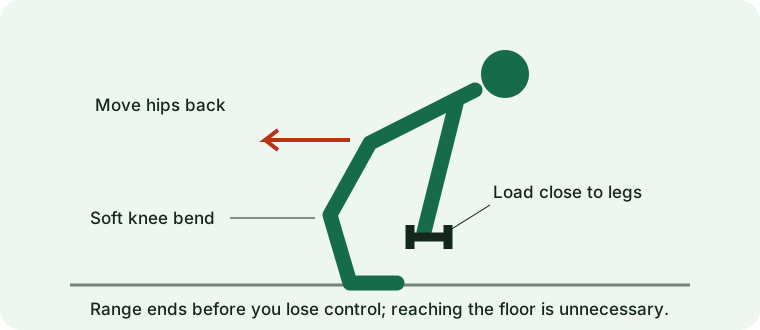
Push the hips behind you while keeping the shins nearly vertical. The weight should travel close to the legs. Continue until you feel strong hamstring tension or can no longer move the hips back without changing spinal position.
Return to standing
Drive the feet into the floor and bring the hips forward. Finish tall with the ribs stacked over the pelvis. Avoid leaning back or aggressively squeezing beyond a neutral standing position.
Loading and repetitions
Beginners can practice with a dowel, light dumbbells, or kettlebell for 2–3 sets of 8–12 repetitions. Add load only when the hinge remains repeatable and the weight stays close to the body.
Frequent errors
- Turning the movement into a squat by pushing the knees far forward.
- Reaching toward the floor instead of moving the hips backward.
- Letting the load drift away from the legs.
- Using speed to bounce out of the bottom position.
Your first practice session
Practice sending the hips toward a wall behind you before adding a load. Keep a small, steady knee bend.
Suggested starting dose: 2 sets of 8–10. Treat this as a starting example for a generally healthy beginner, not an individual prescription. Rest until you can repeat the movement with control, and finish before technique breaks down.
A decision during your set
If the dumbbells reach mid-shin before your back starts changing position, that is your current endpoint. Touching the floor is unnecessary.
Record your controlled endpoint and load. Do not count extra depth produced by bending the back as progress.
Choose the next step
Wall hinge → light dumbbells → gradual load. Stay at the current step until your repetitions or holds are repeatable. Progression is optional on a tired day; using an easier version can keep practice consistent.
Evidence behind the training framework
Currier and colleagues, 2023: resistance-training prescription systematic review and network meta-analysis. This review compares training approaches in healthy adults. It provides context for planning resistance training; it does not validate every technique cue or prescribe an individual starting load. The worked examples above are editorial applications, not experimental results.
Is this the same as lifting a weight from the floor?
No. This guide starts from standing and uses a hip hinge. A conventional deadlift starts from the floor with a different setup. Do not force the Romanian deadlift to reach the floor just because the equipment allows it.
Sources and limitations
The practice examples on this page are educational suggestions, not results from a supervised trial or an assessment of your movement. Public-health context comes from the U.S. Department of Health and Human Services’ Physical Activity Guidelines for Americans and the CDC’s physical activity guidance. See our editorial policy for how we research, write, review, and update content.